
Measuring Digital Transformation ROI with AI Outcomes

"True wealth is not of the pocket, but of the heart and of the mind." - Kevin Gates

A Tough Challenge
The concept of digital transformation is an established part of modern business discourse. It is a disciplined process that involves redesigning business models, operational procedures, and customer experiences by embedding digital technologies throughout an enterprise. This is not simply a matter of replacing analog processes with digital ones; it is a business strategy initiative and a fundamental effort in change management. Today, this conversation is dominated by AI. Organizations are actively deploying AI and its related technologies, like automation, to streamline workflows, enhance decision-making, and create new products. The financial commitment to this evolution is substantial. Global private investment in generative AI alone reached $33.9 billion in 2024, representing an 18.7 percent increase over 2023.
Despite this massive financial commitment, a curious paradox has emerged. A recent study revealed that a significant majority of generative AI projects, as many as 95 percent, are failing to deliver meaningful business results. Most corporate AI deployments are not producing measurable value. This troubling reality prompts a critical question: why? The problem is not a failure of the technology itself, which is advancing at an unprecedented rate. We believe it is a failure of approach, rooted in a fundamental "learning gap.". Companies have been eager to deploy these new tools without investing in the strategic work required to adapt them to their specific business processes and cultural context. They are chasing the promise of technology without a clear vision for how it will generate value. This focus on technology adoption over strategic outcomes is the primary challenge. The core problem is not about building artificial intelligence; it is about building an organization that can successfully use AI to create lasting value.
In this article, we will present a principled framework for measuring the value of AI in a way that moves beyond a single number. It is a practical guide for both business leaders and technology practitioners, grounded in real-world examples and a long-term view of success. By understanding the true nature of digital transformation and the evolving face of its measurement, organizations can navigate this complex landscape and secure tangible returns.
The First Principle of Transformation
Before any discussion of measurement can begin, a clear understanding of what is being measured is essential. Digital transformation is not, at its heart, an information technology project. It is a strategic business initiative that seeks to embed new technologies across all areas of an organization to enable continual and rapid innovation. Technology serves as the enabler for this profound change. Cloud computing, for example, provides the agility and scale necessary for enduring success. Mobile technology has fundamentally reshaped business models, creating entirely new ones in the process. The Internet of Things and Digital Twins link the digital to the physical world, creating a universe of data. Artificial intelligence and automation provide the tools to process this data, streamline workflows, and enable new products and services.
A technology-centric approach, which focuses solely on the implementation of new tools, is often misguided. The most effective transformations take a holistic view, recognizing that technology is just one piece of a larger puzzle. This holistic approach integrates five key elements: data-driven insights, technology-enabled operations, new digital products, a positive change culture, and a clear strategic direction. The absence of any of these elements can render the entire effort ineffective. Without a clear strategic direction, a company may simply automate old, inefficient processes instead of redesigning a truly new way of working. This is a primary reason why many pilot projects fail to scale beyond their initial scope. The high failure rate of AI projects, despite massive investment, is a direct symptom of this failure to address the foundational cultural and operational shifts that make the technology effective.
The evidence points to a clear relationship. A technology-first approach, where tools are adopted without a corresponding shift in strategy and process, leads directly to poor integration and a lack of measurable value. This is the "learning gap": the value of AI is not inherent in the technology itself but in its successful integration into business operations. A company must first define its strategic goals and then select the technology that will enable them, not the other way around. The most successful organizations understand that transformation is a continuous process of evolution. They build an "evolvable architecture," a principle that applies as much to the business as it does to the software systems that run it.
The Evolving Face of ROI
The traditional formula for return on investment is a straightforward calculation: income minus investment, divided by (investment multiplied by 100%). This metric is a powerful and sufficient tool for short-term marketing campaigns or simple capital expenditures. However, it is an insufficient measure for the value of a complex, long-term initiative like AI-driven transformation. The most significant benefits of AI are often indirect, long-term, and difficult to quantify. These benefits include enhanced innovation, improved decision quality, and better customer or employee experiences.
To properly address this measurement challenge, it is necessary to distinguish between two categories of return: hard return on investment and soft return on investment. Hard return on investment consists of tangible effects directly related to profitability. Examples include cost savings from process automation or increased revenue from a new digital channel. Soft return on investment, conversely, includes intangible benefits that are harder to measure, such as enhanced employee satisfaction, improved brand perception, or increased organizational agility.
The true value of artificial intelligence lies in its ability to deliver these strategic benefits, but measuring them is complex. This creates a "measurement paradox". The difficulty in proving value is a key reason for the high failure rates of AI projects. When leaders cannot articulate or quantify the full benefits of an initiative, they are more likely to abandon it. If it does not deliver immediate, quantifiable financial returns, it is canceled. The traditional ROI formula creates a "quantification bias.". Projects are judged solely on hard metrics, which ignore the critical soft benefits that are essential for long-term competitive advantage. This leads to a vicious cycle: the absence of a proper measurement framework leads to a failure to prove value, which in turn leads to project termination. Focusing on hard ROI alone is a flawed strategy that fails to capture the full scope of value a successful transformation can deliver.
A Multi-Dimensional Framework for Measurement
The solution to the measurement paradox is a comprehensive framework that captures the full spectrum of AI's benefits. A single metric evaluation is insufficient. The most successful digital transformations measure return on investment across four key dimensions, providing a holistic view of the initiative's impact. This approach is often referred to as a Balanced Scorecard. It allows organizations to connect technical achievements to business outcomes in a way that resonates with both technical teams and executive leadership.12
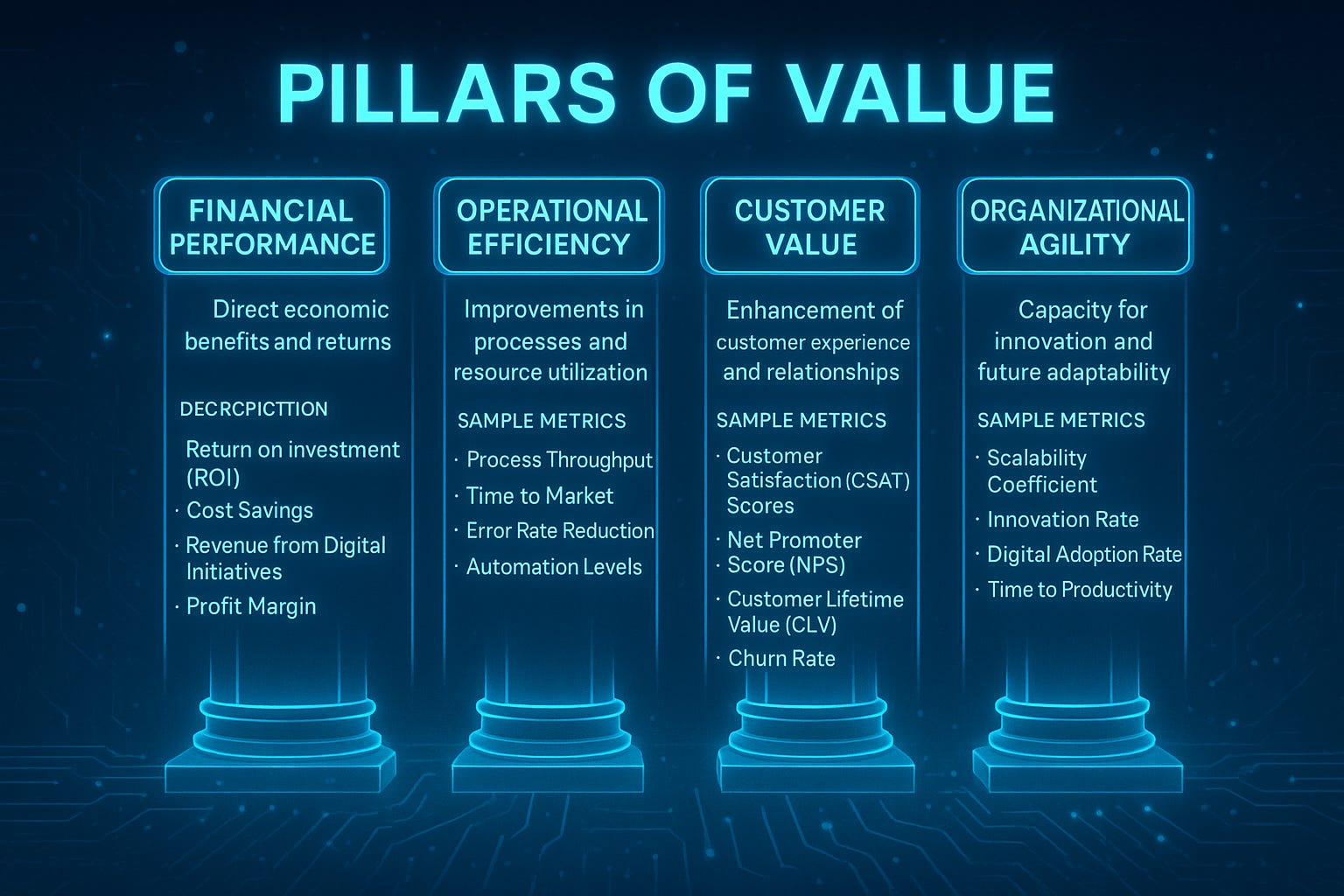
The framework is built on four core pillars of value:
Financial Performance: This dimension focuses on traditional metrics like cost reduction and revenue growth, quantifying the direct economic benefits of the transformation.
Operational Efficiency: This pillar evaluates how digital initiatives streamline internal processes and improve day-to-day operations. It is a measure of an organization's ability to do more with less.
Customer Value: This dimension tracks how the transformation enhances customer interactions, satisfaction, and loyalty.
Organizational Agility: This measures the transformation's impact on the company's ability to innovate, adapt, and build new capabilities. It is a measure of long-term strategic advantage and a company's capacity for future growth and innovation.
Adopting a multi-dimensional framework is a strategic act of acknowledging that the value of AI is not a single number but a collection of effects. This requires a shift in mindset from a purely financial perspective to a holistic approach. The balanced scorecard approach forces an organization to look at all aspects of its business, preventing the "quantification bias" and ensuring that valuable but intangible benefits are not ignored. The causal relationship is clear: a holistic measurement framework leads to a more complete understanding of value, which enables better strategic decision making and secures long-term success.
A visual representation of this framework helps clarify its structure and purpose.
The Metrics That Matter
To implement a multi-dimensional framework, the selection of the right key performance indicators is a critical step. The choice of metrics must align directly with the strategic goals of the digital initiative. The sheer number of potential metrics is a challenge in itself, often leading to "analysis paralysis" or an unfocused effort to track too many variables. The most effective strategy is to choose a small, balanced set of five to seven measures that are directly tied to the primary strategic goals. This focused approach leads to clearer reporting and better resource allocation.
Financial Indicators
These metrics quantify the economic gains of the transformation. Cost savings can be measured by the decrease in labor costs due to automation, reduced rework from lower error rates, and enhanced efficiency in processes. Revenue from new digital initiatives can be tracked through new income streams generated by AI-powered products or services. For example, a logistics enterprise aiming to improve supply chain visibility and fleet productivity must first set a clear and concise digital transformation goal before it can determine the right return on investment target.
Operational Metrics
These metrics measure efficiency and productivity gains. Process throughput tracks the volume of completed tasks per unit of time before and after the AI implementation. Time to market measures the time from the initial concept to the final deployment of new products or features. Error rate reduction quantifies the decrease in inaccuracies after the AI system is integrated, as AI is often implemented to reduce human mistakes and improve precision.
People Centric Metrics
These metrics measure the impact of the transformation on human experience, both for employees and customers. For employees, it is essential to track digital adoption rates, time to productivity for new hires, and employee satisfaction ratings. For customers, it is important to monitor satisfaction scores, response times, and customer lifetime value uplift to gauge the effect of AI on their experience.
Strategic Metrics
These metrics measure long-term value and competitive advantage. The scalability coefficient is a critical measure of how well an AI solution can expand without costs skyrocketing. It is the difference between a thriving initiative and a financial burden. The innovation rate measures the company's ability to create new digital products or services. A focused, metrics-based approach leads to clearer reporting and better resource allocation. There is no single correct formula. The right metrics are those that matter most for the specific business objective.
Fostering a Culture of Success
Technology alone is not enough to secure a positive return on investment. The key to overcoming the high failure rate of AI projects lies in a fundamental shift from a technology-centric to a human-centric approach. This is how the "learning gap" that plagues many projects can be closed. Success is not in the code; it is in the culture.
Every initiative should begin by answering two key questions: what business problem does it address, and how does it advance our strategic goals? Defining a clear objective is the foundation upon which all success is built. This ensures that the AI project is not an isolated experiment but a direct contributor to the organization's strategy.
AI is only as good as the data it is built upon. Poor data quality is a common issue that can skew performance and lead to inaccurate conclusions about a project's effectiveness. Investing in robust data collection, management, and cleansing practices is a non-negotiable prerequisite for a successful outcome.
An AI transformation is an ongoing process, not a one-time event. Work should be done iteratively by introducing AI in small stages to prevent fatigue and reduce risk. This approach allows teams to learn from implementation and tweak the system over time as they discover what is effective and what is not.
Silos are an enemy of progress. Organizations must break them down and build cross-functional, multidisciplinary teams with diverse skill sets. This reduces bottlenecks and ensures that AI systems are effectively integrated across the entire organization. The strategist of tomorrow needs to understand how AI works, and the technologist needs to understand the business problem.
Finally, it is paramount that leaders communicate clearly and avoid overwhelming people with technical jargon. Leaders must articulate the tangible benefits for different teams and provide context for the numbers. The research points to a clear pattern: projects fail when they lack a clear strategy, when they rely on generic models, and when they fail to get employee buy-in.4 The solutions must be human-focused, involving a positive culture, multidisciplinary teams, and effective communication. The most effective strategies involve continuous improvement and a willingness to learn from user data.
The Theory in Practice
The best way to understand these principles is to see them in action. While most projects fail, some organizations are achieving remarkable results. These successful cases provide a tangible counterpoint to the high failure rate and prove that AI can deliver significant value when applied correctly. The difference between success and failure is not the technology, but the strategic approach and execution.
In a Harvard study, management consultants who incorporated AI tools completed tasks 25.1 percent more quickly and accomplished 12.2 percent more tasks in total, with over 40 percent higher quality. Another company automated sales call auditing, customer retention analysis, and field services processes, which were projected to save 35,000 work hours and boost productivity by at least 25 percent.
In the realm of customer experience, Pentagon Federal Credit Union used an AI-powered chat interface to increase completed loan applications by 20 percent and improve customer satisfaction by 30 percent. The results were immediate and measurable.
For operational efficiency, a company used a platform to securely tap into internal data. Within two months of its rollout, 8 percent of staff were actively using the platform, media inquiries were processed 50 percent faster, and more than 40 use cases were documented.
These examples demonstrate that when AI is implemented with a clear strategy and a focus on measurable outcomes, the returns are not just theoretical; they are transformational. These examples provide proof that a principled approach yields success, while a rushed approach leads to failure.
Now it’s Time to Build
The challenge of measuring the value of AI in digital transformation is clear. It is not a technology problem; it’s an approach. We must move beyond a narrow view of return on investment and adopt a multi-dimensional framework that captures the full spectrum of value. We must choose the metrics that truly matter and align every initiative with a clear business objective.
The journey of digital transformation is never truly finished. It is about building an evolvable architecture that can adapt and grow as your business changes. There are very few one-way doors in software. You can and should reevaluate your systems regularly, because they will run much longer than the time it took to design them.
The time to start is now. Bring your key stakeholders together. Document your current state, define your AI vision, and outline your initial roadmap. Every day you wait, another competitor might be gaining ground.