
The Foundation of Intelligence: 5 Non-Negotiables for AI Success

"Data is the new oil" - Clive Humby

Systems Architecture is Never Finished
In the world of large-scale distributed systems, there is a fundamental law: everything fails, all the time. This is not a pessimistic view; it is a pragmatic one. When you are processing trillions of requests and managing petabytes of data, events with a low probability of occurrence become certainties. As we enter 2026, we must apply this same rigor to our AI strategies. We have moved past the era of isolated experimentation. AI is no longer a “tool” we add to our stack; it is the infrastructure on which the 21st-century enterprise is built.
However, many organizations are building their AI houses on sand. They are chasing the latest frontier models while ignoring the structural cracks in their data foundations. Success in this “never normal” era requires a return to first principles. It requires a relentless focus on evolvability, simplicity, and, above all, the integrity of the information that fuels our systems.
If we want to build systems that scale, systems that our customers and employees can actually trust, we must embrace these five non-negotiables for AI success.
Non-Negotiable One: Master Data Management as the Intelligent Backbone
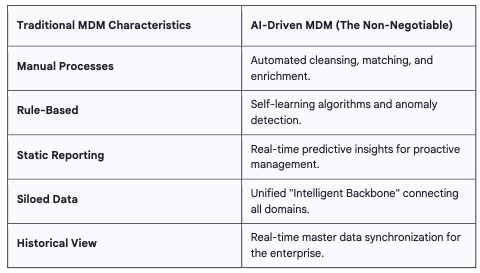
The first and most critical non-negotiable is the absolute necessity of Master Data Management (MDM). For decades, MDM was viewed as a “back-office” project—a quest for the “Golden Record” to satisfy some compliance requirement or clean up a mailing list. Those days are over. In the age of AI, MDM is the “intelligent data backbone” that connects every application, every system, and every user.
AI models are fundamentally predictive engines. They look for patterns and relationships. But if the data they are training on is rife with duplicates, inconsistent formats, and missing details, the patterns they find will be hallucinations. According to recent data, over 60% of enterprises report issues with inconsistent master data, leading to delayed decisions and lost opportunities. When an AI system in a Chicago healthcare network tries to surface evidence-based treatment options but cannot reliably link a patient’s historical records due to poor identity management, the result is not just a technical failure; it is a risk to human health.
Modern MDM must be AI-driven. It must move beyond static, manual rules to use self-learning algorithms that can detect duplicates and suggest corrections in real-time. This is the foundation of “AI-Ready Data”. By implementing standardized data quality rules and centralized management, organizations can reduce data management costs by 30% while significantly enhancing the reliability of their AI initiatives. If you haven’t solved your identity problem, you haven’t started your AI journey.
Non-Negotiable Two: Semantic Precision and the Context Layer
Data alone is not enough; AI requires machine-readable context to be successful. This is the second non-negotiable: the creation of a robust semantic layer composed of business glossaries, taxonomies, and ontologies. Without this layer, an AI model might know that a number exists, but it won’t understand what that number means in the context of your specific business.
We are seeing a massive shift toward “Semantic GraphRAG”, the use of knowledge graphs to ground AI responses in enterprise-specific truth. This is how we combat the “Data Divide”, the disparity in data access and context that mirrors social inequalities. By imbuing data with semantics, we allow AI to understand the relationships between slow-changing geographical features, evolving infrastructure, and real-time operational data.
In the 2026 enterprise, a “non-negotiable” component is a unified entitlements framework that ensures AI only retrieves data that the user is authorized to see. This prevents the risk of “user re-identification,” where AI might combine innocuous data points to expose private identities. We must build systems that understand not just the content of our data, but its intent and its boundaries.
Non-Negotiable Three: Evolutionary Architecture and Decoupling
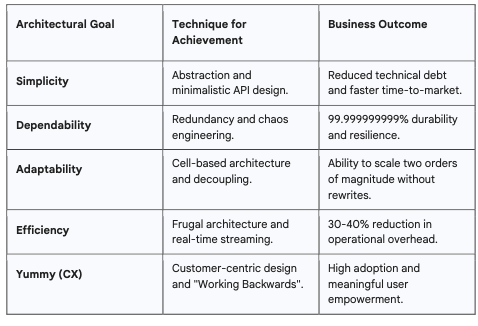
The third non-negotiable is a commitment to evolutionary architecture. You should never lock yourself into your architecture, because with two or three orders of magnitude of scale you will have to rethink/redesign it. This is why we must stop building “monoliths” and move toward “decoupled architectures”.
By decomposing services into small, well-understood building blocks with well-defined APIs, we can isolate issues without impacting the rest of the system. This is the “Distributed Computing Manifesto” for the AI era: the separation of presentation, business logic, and data. Applications should be prohibited from accessing the database directly; instead, they must interact through service interfaces that encapsulate the necessary business logic.
This decoupling allows our data systems to evolve. We can change the underlying data structure, perhaps moving from a traditional relational model to a NoSQL or vector store, without breaking the applications that rely on it. As Werner Vogels famously noted, “APIs are forever”. Being conservative and minimalistic in your API design is the only way to build fundamental tools on which others can reliably build.
Non-Negotiable Four: Active Governance and Automated Monitoring
In an era of “Agentic AI”, where autonomous agents are moving from simple task automation to actual outcome ownership, traditional, passive governance is insufficient. The fourth non-negotiable is “Active Governance”: the use of AI to automate the discovery, classification, and protection of our data landscape.
Only one in five companies currently has a mature model for the governance of autonomous AI agents. This is a massive risk. We need “continuous monitoring” of model behavior, ethical frameworks for automated decisions, and protocols for human intervention. Active governance means that policies are not just written in a document; they are automatically enforced at the point of data access.
This requires a “Data Marketplace” approach, where data producers and consumers collaborate in a single environment for data sharing. This fosters trust and transparency, ensuring that everyone understands the “data contract”, the terms of usage, the metrics for quality, and the lineage of the asset. Trust is not something you “install” at the end of a project; it is something you architect into the system from day one.
Non-Negotiable Five: Outcome-Driven Engineering and the Frugal Mindset
The final non-negotiable is a shift from “AI experimentation” to “AI outcomes”. Too many organizations are caught in the “Legacy Trap,” spending more time patching servers than building new features. In 2026, the focus must be on performance and the real measurement of business results.
This is the core of being a “Frugal Architect”: making every architectural choice with a deep understanding of its cost and its value. We must prioritize “low-latency responses” and “predictable systems”. This means moving toward “real-time data platforms” that support streaming analytics rather than old-school batch processing.
Ultimately, AI will be evaluated the same way any core business capability is: by the value it delivers to the customer and the efficiency it brings to the operation. We must move beyond “hype-driven” development to “outcome-driven” engineering. This requires a much more disciplined approach to software engineering, where we “Work Backwards” from the customer’s needs to find the simplest, most robust solution.
Building It
The challenges of 2026 are significant, but so are the opportunities. For IT leaders, the message must be clear: do not get complacent with your architecture. Revisit your choices with every order of magnitude of growth. Acknowledge that “everything fails” and build systems that can recover gracefully.
Focus on the Product thinkers within your organization, those who understand that AI success is not about the shiny frontend, but about the integrity of the data and the resilience of the architecture underneath. Establish your MDM as the first non-negotiable. Build your semantic context. Embrace evolutionary design. Automate your governance. And measure your success by the outcomes you deliver.
The era of AI in the human loop is here. This cycle will create massive opportunities to solve problems that truly matter. But it will only work for those who have the courage to build on a solid foundation.