
The ROI isn't missing. The redesign is.
Everyone's saying AI should be an operational lever, not just a tool. Fine. But what does that actually mean when you're running a real business with real deadlines?

"Give me a lever long enough and a fulcrum on which to place it, and I shall move the world." — Archimedes

I keep seeing the same post cycle through my feed. AI is stalling in enterprises. The ROI isn’t showing up. Companies are running pilots that die in procurement. And the diagnosis is always the same: you’re treating AI as a tool to be implemented rather than a lever to be pulled.
That framing is right. But nobody’s making it real. It’s all positioning with no plumbing behind it.
So let me try to actually close that gap, because this comes up constantly in the work I’m doing with clients right now.
The actual difference
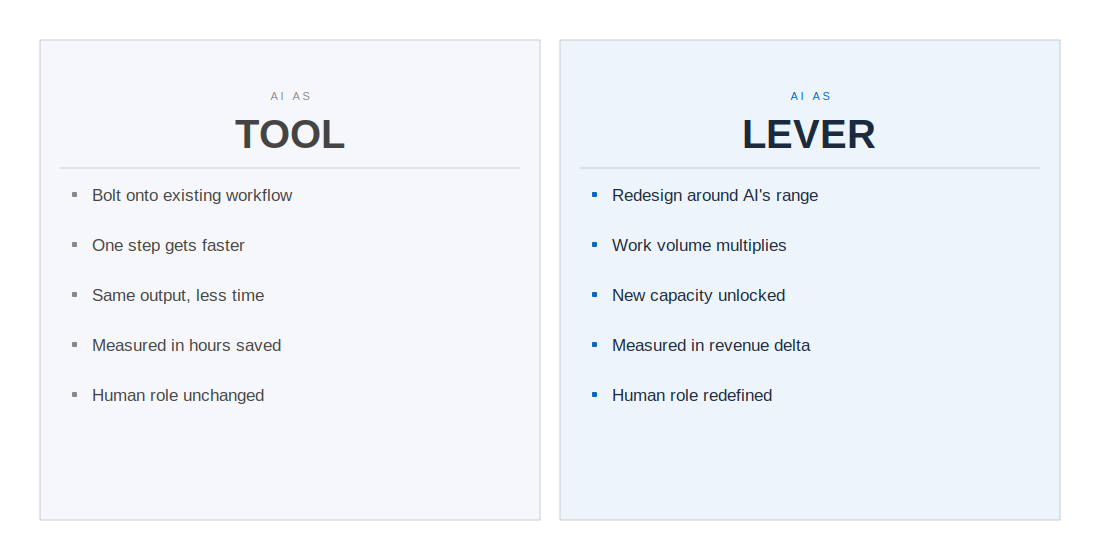
When you treat AI as a tool, you drop it into an existing workflow. One step gets faster. The person doing that step saves some time. You measure the time saved, call it a win, and wonder why the business results didn’t move.
When you treat AI as a lever, you redesign the workflow around what AI can actually do. You ask a different question. Not “how can AI help with this step?” but “if AI could handle 80% of this autonomously, what does the remaining 20% look like and who does it?”
That question sounds small. It isn’t. It forces you to define the human role residually, which almost always surfaces something more valuable: judgment calls, exception handling, relationship work. Things that actually compound.
The three moves that actually make this real
I’m not going to give you a framework with a clever name. I’m going to give you three operational moves. These are the ones I see actually changing business outcomes when clients execute on them.

Most teams are using AI to produce things — drafts, summaries, analyses. That’s tool behavior. Lever behavior is routing decisions. Pricing within a range. Triage. Account scoring. When AI is producing, humans still decide what to do with the output. When AI is deciding within a defined envelope, humans set the policy and review the edge cases. The headcount no longer scales with the volume of work.

The vague version is “humans stay in control.” Every organization says this, and nobody operationalizes it. The precise version looks like: AI decides autonomously when condition A is met, escalates to a human when condition B is met. That’s your governance model. Without it, people default to reviewing everything, and you’ve built a very expensive autocomplete.

If your metric is time saved per task or prompts used, you’re measuring a tool. If your metric is proposals sent per rep, support tickets deflected per engineer, or pipeline created per BDR, you’re measuring a lever. The number needs to show what you could do before versus what you can do now at the same cost or lower.
What this looks like when it’s working
In services firms right now, the lever is capacity multiplication. Same team, significantly more output. The firms actually doing this have restructured delivery so AI produces the first draft, junior staff does QA and customization, and senior people spend their time on the judgment and relationship work that the client actually values. The economics are completely different from the old model.
In B2B sales, the lever is top-of-funnel volume without proportional headcount. AI handles outreach, qualification, and initial proposal sequences. A rep only enters when there’s a real deal to close. The reps aren’t faster. There are just fewer of them needed to cover the same ground.
In operations, the lever is continuously monitored, replacing periodic review. AI is watching every transaction, every ticket, every contract, surfacing exceptions rather than humans doing sampling. The coverage is total. The cost is flat.
The honest reason you see mostly conceptual fluff about this: the businesses actually doing it have competitive advantage in it and aren’t publishing playbooks. The consultants who aren’t doing it yet are writing thought leadership about it.
The question that cuts through
When I’m with a client trying to figure out where AI creates real leverage, I’ve stopped asking “where are you using AI?” and started asking: which decisions in your business are still human that don’t need to be? What business challenges can you not hire enough humans to solve?
That question finds the lever. Because most organizations have a huge surface area of decisions that feel like they require human judgment but actually don’t. They require human-defined policy executed at volume. That’s exactly what AI is built for.
Once you find those decisions, you build the architecture that moves them into an AI-governed layer with explicit escalation paths. You define what AI handles autonomously and what it surfaces for human review. And then you measure the business outcome, not the AI activity.
That’s what it means to use AI as a lever. It’s not a mindset shift. It’s a workflow redesign with a governance model and a business metric attached to it.
Start there!